


History
Artificial grass was first introduced in Houston USA during the 60’s. The aim was to provide a real grass experience with a more affordable cost and a longer lifespan. With the new technologies developed in recent years, the performance results obtained with synthetic turf have become even better than the natural grass. Recent tests show that players’ health and game play with artificial grass are superior compared to natural grass. On top of that, all of these benefits are obtained with a lower cost than natural grass.
Because of the different types of natural grass, it is not possible to get the same performance and game pleasure on every pitch. For this reason, synthetic grass has become even more preferred by international sports organizations. International sports federations such as FIFA, ITF, FIH have gone to standardization in synthetic turf, and they send their demands to producers like us in order to achieve the same performance all over the world.
According to the expectations of these organizations, long-term researches were carried out on issues such as athletes’ health, game comfort and field durability, and the resulting standards are now being applied in all national and international competitions, including world cups.
Comparison
Time
One of the most important features of synthetic grass fields is that time is much more profitable than natural grass. After playing games on natural turf, there are a lot of waiting times such as resting the field for 1 day, repairing certain areas after hard games (especially in the penalty area), drainage of the ground in the rainy or snowy weather and restoration.
When playing on synthetic turfs, you can play multiple games consecutively, there is no need to rest the turf or repair areas that are used the most. The artificial surface does not get effected by bad weather conditions and if the drainage has been made properly, even the toughest weather conditions will not interrupt your game.
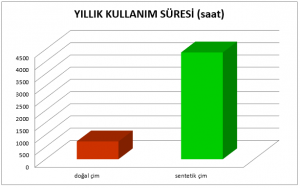
In terms of profitability, the average usage time of 4 hours per day on natural grass fields and 12 hours on synthetic grass fields mean more profit for the investor. Therefore, synthetic grass fields are more advantageous and are more cost-effective in a shorter term. You can see more clearly with the comparison figures from the time table below.
More games played = more efficient = more profit
YEARLY GAME TIME (HOUR)
Cost
Although the initial cost of a synthetic grass is higher than natural grass, the annual fixed low maintenance costs make it highly profitable for the investors. There are no high maintenance costs such as irrigation, spraying, fertilization, patching worn out areas (re-seeding), as in natural turf areas. These costs increase every year because of the aging of the natural grass structure over time.
Cleaning and maintenance of synthetic grass is very cheap and simple. With a special cleaning brush, periodic scrubbing and irrigation to cool down in extreme hot weather is sufficient. Granulation reinforcement may be required at most once a year, depending on the frequency of use.
As a result, there are no expensive and long-running maintenance costs like natural turf, which means that the investor will profit in a shorter period of time.
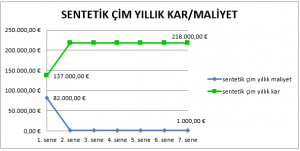
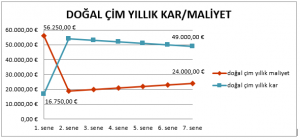
In the graphs below, profit and cost calculations are made for a field of 6.000m². The difference is clearly visable. 7-year profit and cost graphs were prepared assuming that the synthetic grass field’s hourly income is 50 € and the natural grass hourly income is 100 €. Initial installation costs of the fields were also taken into consideration.
Safety and performance
In terms of the health and performance of the athlete, synthetic grass has been found to be more beneficial in the as a result of FIFA accredited tests. The structure of the grass and the filling materials used minimize the risk of injury to the players. As a result of the running, stopping and agility tests applied on the players, the performance of the players on synthetic grass increased by 15% -20%.
Weather conditions and durability
Synthetic turf fabrics produced according to FIFA standards are UV protected and extremely resistant to rain, snow and extreme hot/cold weather conditions. If the drainage application is done properly, there will be no problems such as flooding or drying out of the field as these problems occur with natural grass.
Eco-friendly
Synthetic grass fields have no need for applications such as irrigation, spraying and fertilization. Thus, compared to natural grass, you can save about 30 tons of water per year. You will also avoid harmful spraying and fertilizer application to the environment. Due to its polyethylene or polypropylene structure, synthetic grass It does not harbour harmful bacteria or micro organisms.
Standardization
Under the FIFA quality concept (FQC), it is possible to get the same performance in synthetic turf areas all over the world. Thus, the field differences that have appeared in the away games have been abolished and the same game comfort and safety is guaranteed in any location and climate.

Bir Cevap Yazın